Heart & Stroke Risk Screen Tool
Prompting at-risk populations to proactively seek cardiopulmonary & brain health care.
Lead Product Designer
Heart & Stroke Foundation

The Challenge
Heart disease and stroke risk is unevenly distributed across Canada — and so is awareness of it. For certain populations, barriers to health information aren't just logistical; they're cultural, linguistic, and deeply personal. Heart & Stroke Foundation needed a tool that could reach people for whom risk awareness was critically low, and do it in a way that felt safe, relevant, and trustworthy — not clinical or threatening.
The interface itself was relatively simple: an online screening quiz. The complexity was entirely in the content.
The Process
As part of a 2.5 person Slalom team (an analyst, a part time engagement lead, and myself), I worked across research, design, and testing to shape an experience that could hold up under real scrutiny — from medical and legal SMEs, from qualitative affective testing, and from the target populations themselves.
A significant part of the work was navigating the client team's own anxiety about the project. The subject matter — race, weight, medical history, cultural health misinformation — needed to be treated with sensitivity, and early on that manifested as decision paralysis. Redirecting that energy toward structured SME consultation, and getting real feedback from testing copy and placements gave the team a path forward and the confidence to proceed.
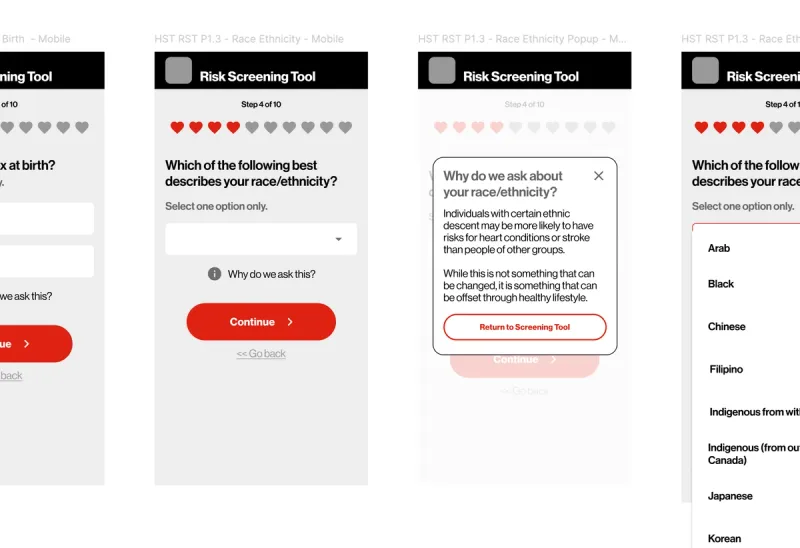
One of the more quietly effective design decisions was a small one: a contextual "Why do we ask this?" disclosure pattern, surfaced inline on all questions, but held particular significance for more sensitive questions like race/ethnicity and medical history. Rather than burying the rationale in legal copy or avoiding the explanation altogether, we put it exactly where the discomfort would occur — giving users a clear, human-readable reason before they decided whether to answer. It didn't remove the sensitivity of the questions, but it reframed them as transparent, purposeful, and considerate about differentiating factors rather than intrusive.
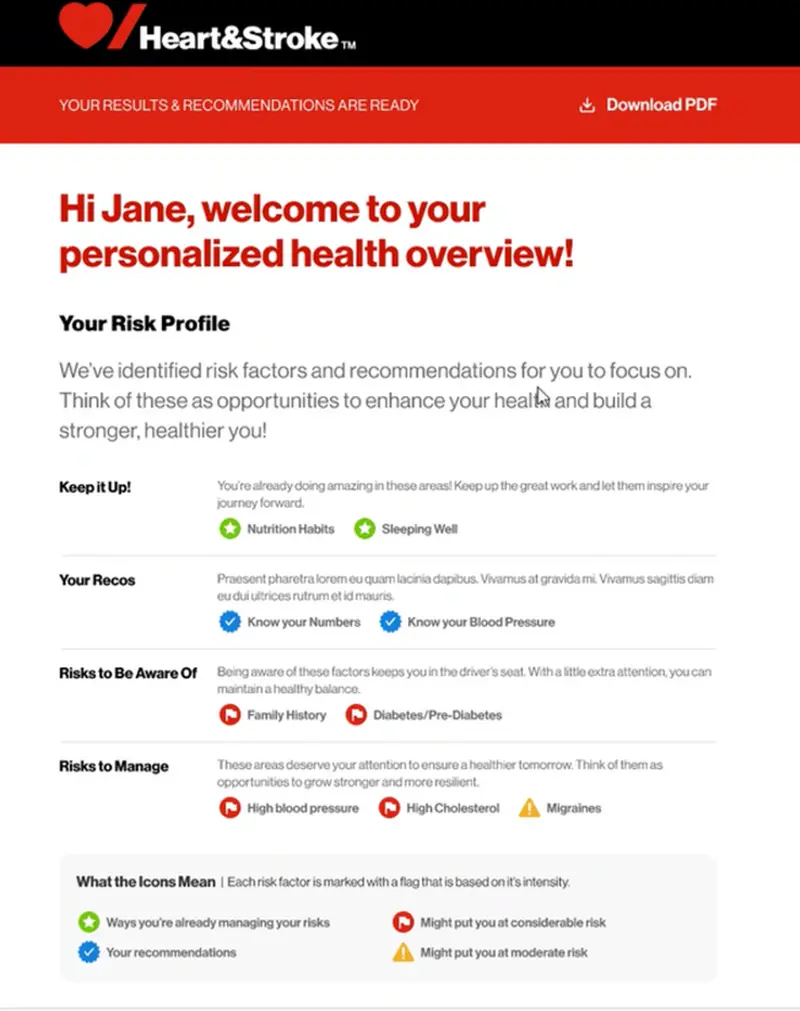
UX writing was the sharpest design tool on this project overall. A single word choice — in a question, a label, an outcome headline — could cause a respondent to disengage, feel judged, or abandon the experience entirely. We ran extensive copy testing, softened language and imagery where needed, and carefully designed the outcomes page — the most complex deliverable — to communicate tiered risk levels without triggering fear or shame. The final structure (Keep it Up, Your Recos, Risks to Be Aware Of, Risks to Manage) was the result of several rounds of language testing to find a tone that felt honest without feeling clinical or alarming.
We also identified an opportunity beyond the current scope: a future, more dynamic experience integrating IoT and device health tracking — allowing the tool to imply answers rather than directly asking sensitive questions.
[ARTIFACT: Flow spread — Image 2] Post-testing iteration spread — 20+ screens refined across multiple rounds of qualitative testing.
Outcomes
The tool launched to quiet general availability and landed well. Medical professionals reached out to the Foundation to report that patients were proactively prompting cardiopulmonary conversations — unprompted, based on having taken the survey.
Several research participants — people we'd recruited specifically because health information had been hard for them to access — told us they planned to find a doctor, book an appointment, or take other concrete steps in the days following their session. That wasn't a metric we could track in a dashboard, but it was the whole point.
Our recommendation to follow up with a personalized guide was adopted for GA release and received strong response from both participants and stakeholders.
Key Contributions
- Led UX writing strategy and copy testing across all question types and outcome states
- Designed the "Why do we ask this?" inline disclosure pattern for sensitive question handling
- Shaped the tiered outcomes page structure and risk-level language
- Facilitated team alignment during periods of high uncertainty, guiding the group toward SME consultation and testable decisions
- Negotiated with the client's marketing team to expand the colour palette for accessibility and contextual clarity
- Shaped the follow-up email recommendation and its personalization approach
- Because of the nature of the content being collected, we recommended that data security be prioritized in the buildout.
- Contract ended with the design deliverables and work continued with our technical implementation team.
Lessons Learned
Sensitive subject matter does require a special type of handling. The most valuable thing I did on this engagement wasn't a design deliverable; it was helping a conscientious team find their footing through design process, testing, and validation so they could feel confident in their release.